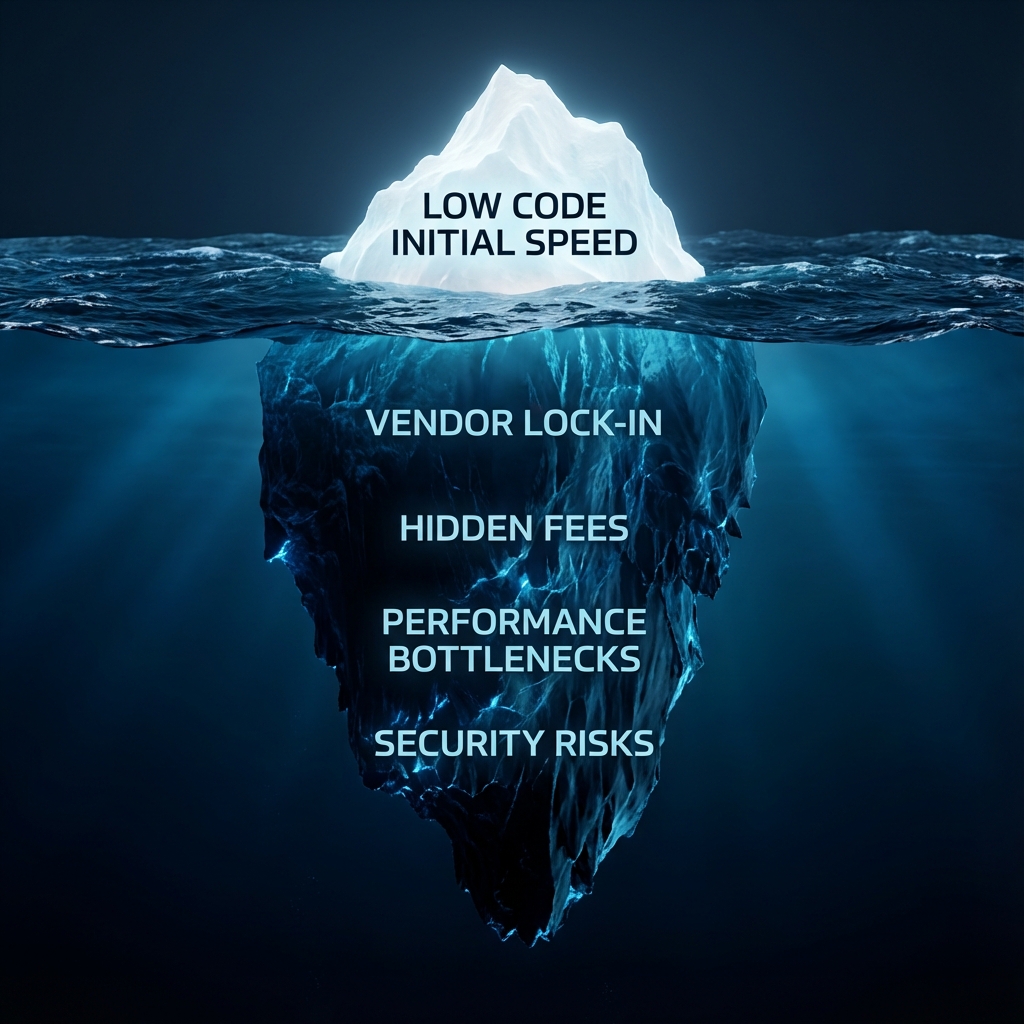
The Hidden Costs of Low-Code Platforms for Enterprise
"Build apps in minutes, not months."
The sales pitch for Low-Code/No-Code (LCNC) platforms like OutSystems, Mendix, Bubble, and PowerApps is seductive. For C-level executives facing a developer shortage and a backlog of internal tools, it sounds like a silver bullet.
And strictly speaking, the pitch is true. You can build a prototype in minutes.
But enterprise software is not about the first 10% of development; it's about the remaining 90% of maintenance, scaling, and integration. This is where the Low-Code Iceberg reveals itself.
In this article, we explore the long-term technical and financial implications of betting your business on LCNC platforms.
1. The Vendor Lock-In Trap
When you write custom code (React, Node.js, Python), you own the IP. You can host it on AWS, Azure, DigitalOcean, or your own basement server. If AWS raises prices, you move to Google Cloud.
With Low-Code, you rent your software.
The Runtime Dependency
Most enterprise LCNC platforms require their proprietary runtime engine to function. You cannot simply "export the code" and run it elsewhere. If you stop paying the subscription, your application stops working.
The Pricing Cliff
LCNC pricing models are often based on "users" or "operations."
- Year 1: 50 users. $10k/year. Affordable.
- Year 3: 5,000 users. $1M/year.
We have seen companies forced to rebuild entire systems from scratch because the LCNC licensing fees eventually exceeded the cost of hiring a full team of custom developers.
2. The Performance Ceiling
Low-code platforms operate on a layer of abstraction. They generate generic SQL queries and wrap logic in interpreters.
For a simple CRUD app (Create, Read, Update, Delete) with 100 users, this is negligible. For a high-frequency trading platform, a real-time logistics tracker, or a consumer app with 10,000 concurrent users, it is catastrophic.
The "Black Box" Query Problem
In custom development, an engineer can optimize a SQL query, add an index, or implement Caching (Redis) to fix a slow endpoint. In Low-Code, you often lack access to the underlying query execution plan. You are at the mercy of the platform's optimization engine. When the "automatic" optimization fails, you hit a hard performance ceiling that no amount of money can bypass.
3. Shadow IT and Security Nightmares
Designers and citizen developers love LCNC. Security teams hate it.
Because these platforms make it easy for non-technical staff to connect databases and APIs, they bypass standard DevSecOps pipelines.
- Data Leaks: A citizen developer accidentally exposes a sensitive customer endpoint because they didn't understand the permissioning model.
- Compliance: Does the platform store data in the EU? Is it HIPAA compliant? Often, these "app builders" launch tools without vetting compliance, creating massive liability.
4. The 80/20 Rule of Customization
LCNC is great for the standard 80% of functionality.
- "I need a login screen." (Easy)
- "I need a form to update user data." (Easy)
But what about the unique 20% that gives your business its competitive edge?
- "I need a custom algorithm to calculate insurance risk based on live telematics data."
- "I need a highly specific UI interaction that isn't in the component library."
In custom code, you just build it. In Low-Code, you spend weeks fighting the framework, writing "glue code" or "custom widgets" that are brittle and hard to maintain. You end up spending more time hacking the platform than you would have spent writing the code from scratch.
5. When Should You Use Low-Code?
We are not saying Low-Code is useless. It has a specific place in the ecosystem:
- Internal Tools: An admin panel used by 5 operational staff.
- MVP / Prototyping: Validating an idea before committing to a full build.
- Short-Lived Campaigns: A marketing landing page that will be deleted in 3 months.
Conclusion: Value Your IP
Software is an asset. If your core business relies on a platform you do not control, you are building your castle on rented land.
For mission-critical, customer-facing, or high-scale applications, Custom Architecture is not an expense; it is an investment in ownership, performance, and agility.
Ready to own your technology? At Devstract, we rescue companies from the "Low-Code Cliff" by migrating legacy LCNC apps to robust, scalable custom stacks (Next.js, Go, Rust).