Boosting Conversion Rates with AI-Driven UX Design
Marketing teams often obsess over the top of the funnel: Cost Per Click (CPC), Cost Per Mille (CPM), and overall traffic volume. Millions of dollars are poured into Google Ads and LinkedIn campaigns every year. But what happens when that expensive traffic actually lands on your site?
If your user experience (UX) is clunky, generic, or passive, you are pouring water into a leaky bucket.
In 2025, User Experience is Marketing. And the most successful marketing teams are no longer just "optimizing landing pages" with A/B tests on button colors. They are using AI to create hyper-personalized, dynamic, and high-converting experiences that feel like magic.
The Problem: The "One-Size-Fits-None" Website
Current web design has a fundamental flaw: it is static.
Every visitor sees the same headline, the same images, and the same Call-to-Action (CTA).
- The CEO sees the same technical jargon as the Developer.
- The Returning Customer is asked to "Sign Up" even though they already have an account.
- The Mobile User sees a layout optimized for desktop mouse interaction.
This friction kills conversion rates. Studies show that 74% of customers feel frustrated when website content is not personalized. Frustration leads to bounces, and bounces lead to wasted ad spend.
The Solution: AI-Driven Personalization
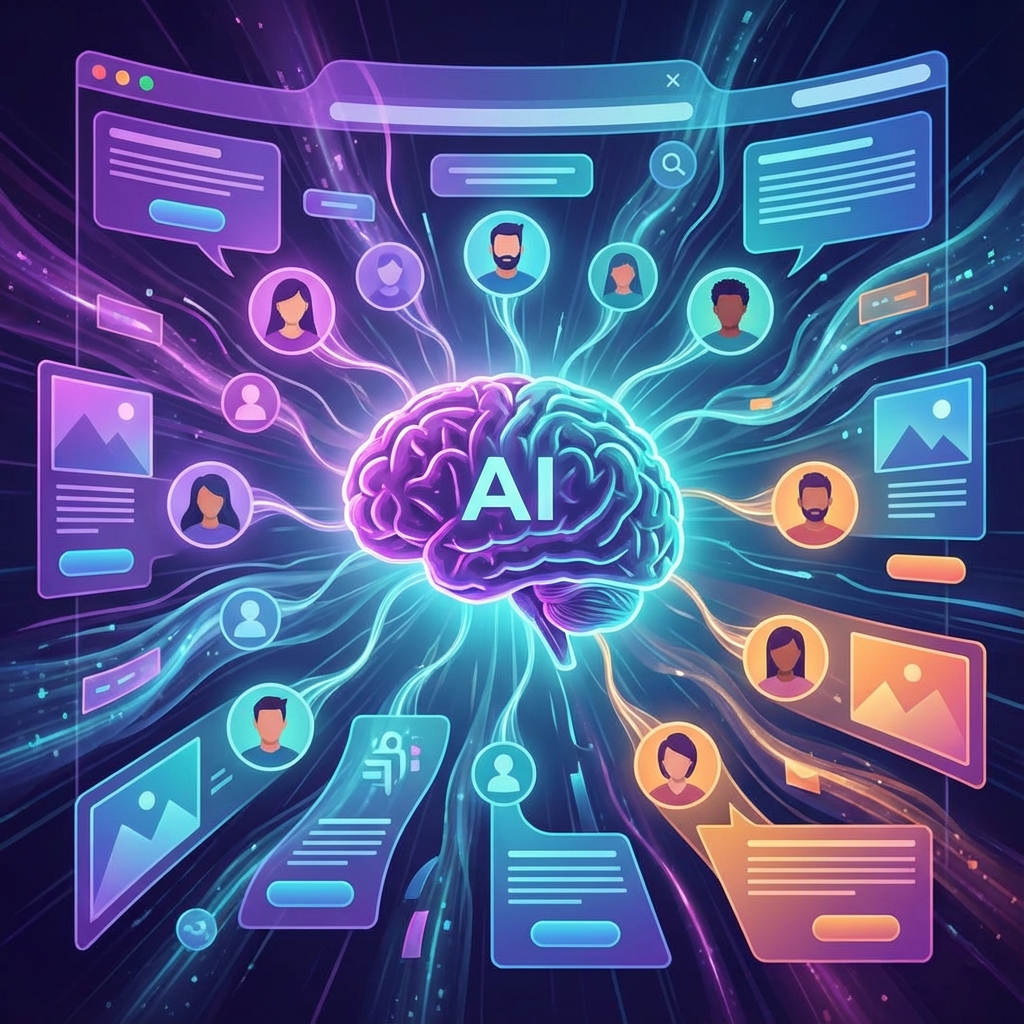
AI allows us to move from static pages to Dynamic User Experiences. By analyzing user behavior, referral sources, and session data in real-time, we can adapt the interface to match the user's intent.
1. Dynamic Content Adaptation: The "Chameleon" Page
Imagine a landing page that rewrites itself based on the ad the user clicked.
-
Scenario A: User searches for "Cheap CRM for small business."
- Headline: "The Most Affordable CRM for Growth."
- Testimonials: From small business owners.
- Pricing: Highlight the "Starter" plan.
-
Scenario B: User searches for "Enterprise Sales Automation."
- Headline: "Scalable Sales Infrastructure for the Enterprise."
- Testimonials: From CTOs of Fortune 500 companies.
- Pricing: Highlight "Contact Sales."
How it works: Tools like Vercel Edge Middleware combined with personalization engines allow us to rewrite the HTML on the server before it even reaches the user's browser, ensuring zero performance penalty.
2. Intelligent Chatbots & Assistants
Forget the "dumb" chatbots of the past that trapped users in loops of "I didn't understand that." Modern AI agents (powered by Large Language Models) act as proactive, knowledgeable sales assistants.
- Context Aware: They know exactly what page the user is on and how long they've been there.
- Goal Oriented: If a user lingers on the pricing page for more than 30 seconds, the bot can gently pop up: "Hi! I see you're looking at the Pro plan. Are you wondering about the API limits or the team seats?"
- Immediate Value: They can qualify leads, schedule demos directly into a calendar, or answer complex technical questions instantly, 24/7.
3. Predictive UX and Anticipatory Design
AI enables "anticipatory design." By analyzing thousands of previous sessions, algorithm can predict what a specific user is likely to do next.
- Smart Search: Search bars that autocomplete with exactly what the user is likely looking for based on their previous clicks.
- Visual Hierarchy: We can subtly highlight the button user is most likely to click, reducing decision fatigue (Hick's Law).
- Churn Prevention: If the AI detects "rage clicks" or erratic mouse movement suggesting confusion, it can automatically trigger a "Need help?" modal with a direct line to support.
Case Study: The "Devstract" Approach
At Devstract, we don't just "design websites"; we build Growth Engines.
For a recent client in the EdTech space, we implemented an AI-driven onboarding flow:
- Segmented Entry: Users were asked one simple question: "What is your main goal?" (Learn to Code, Get a Job, Build a Project).
- Customized Path: The entire dashboard layout, suggested courses, and email drip campaigns completely rearranged themselves based on that one answer.
- Result: A 40% increase in trial-to-paid conversion because users immediately saw value relevant to their specific life goals, not a generic "Course Library."
Why Marketing Heads Pick Devstract
We speak your language. We know that design is not art; it's a function of business goals.
- Data-Backed Design: Every pixel is justified by analytics. We don't guess; we test.
- Speed: We implement and iterate faster than internal IT teams can approve a ticket.
- Integration: We connect your site seamlessly to HubSpot, Salesforce, Marketo, or your custom marketing stack. The data flows both ways.
Conclusion
The future of conversion rate optimization (CRO) is personal. It is about treating every visitor like a unique individual with unique needs.
Stop settling for 1-2% conversion rates. Leverage AI to build a site that listens, adapts, and converts.