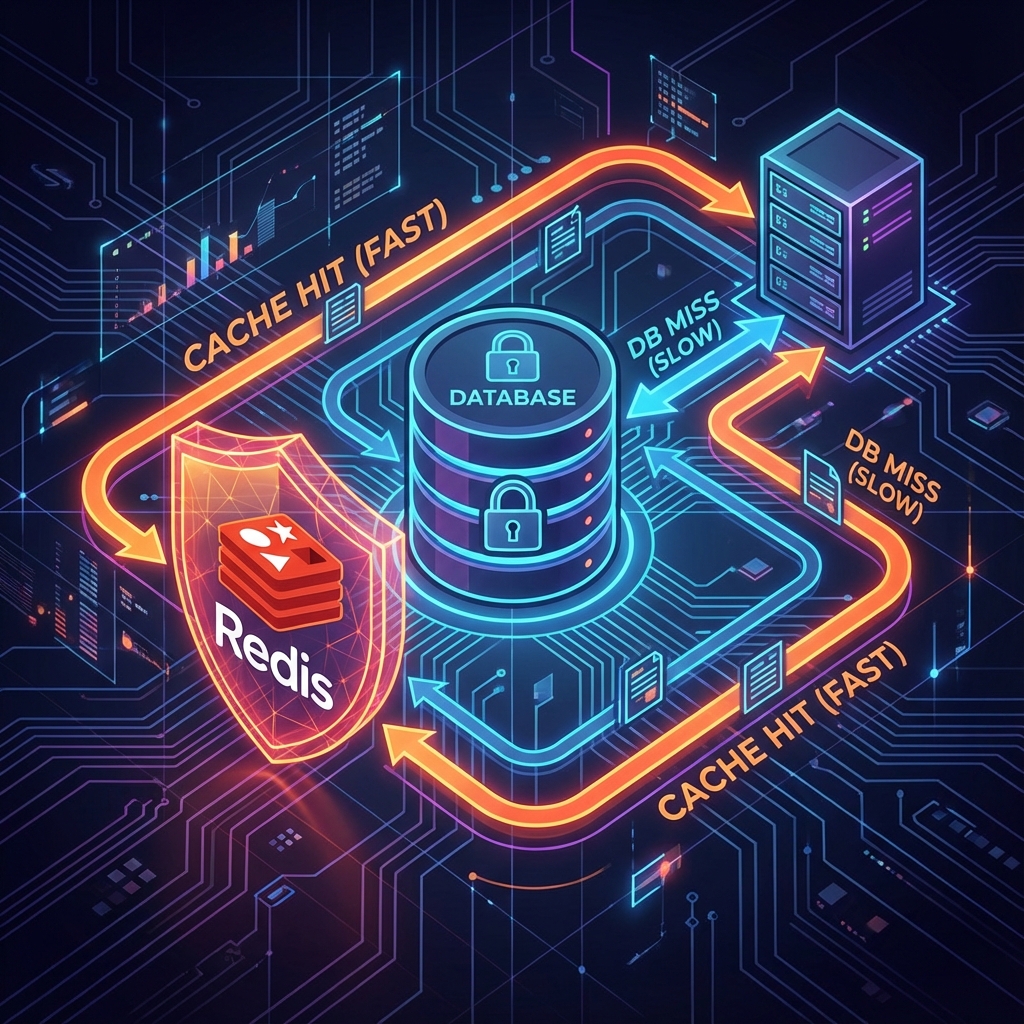
Redis Caching Strategies: The Performance Engineer's Playbook (2025)
"There are only two hard things in Computer Science: cache invalidation and naming things." — Phil Karlton.
Adding Redis to your infrastructure is arguably the quickest way to achieve a 10x performance boost. However, it is also the easiest way to introduce stale data bugs, race conditions, and operational nightmares if mishandled.
Simply blindly executing set(key, value) is not a strategy; it's a liability. In this comprehensive playbook, we will analyze formal distributed caching patterns, determine when to apply them, and demonstrate how to architect robust defenses against the deadly "Thundering Herd" problem.
Part 1: Why Redis? (The Physics of Latency)
Why do we cache? Because Physics.
- L1 Cache Reference: 0.5 ns
- RAM Reference (Redis): 100 ns
- SSD Read (Postgres): 100,000 ns
- Network Roundtrip (AWS Region): 1,000,000 ns (1ms)
Reading from memory (Redis) is 1,000x faster than reading from disk (Postgres). Redis is Single-Threaded. It keeps all data in RAM. It uses an incredibly efficient event loop (epoll/kqueue). It can handle 100,000+ ops/sec on a single core.
Part 2: Caching Patterns
Strategy 1: Cache-Aside (Lazy Loading)
This is the most common pattern. The Application is in charge.
Read Flow:
- App asks Cache for Key X.
- Miss: App asks Database for X.
- App keeps X in Cache.
- App returns X.
Write Flow:
- App writes X to Database.
- App Deletes X from Cache (Don't update it—delete it. It's safer due to race conditions).
Pros:
- Resilient to cache failure (App just hits DB).
- Only caches what is actually requested (Cost efficient).
Cons:
- First request is slow (Cache miss penalty).
- Stale data gap (between DB write and Cache delete).
// Generic Cache-Aside Implementation
async function getUser(id: string) {
  const cacheKey = `user:${id}`;

  // 1. Check Cache
  const cached = await redis.get(cacheKey);
  if (cached) return JSON.parse(cached);

  // 2. Check DB
  const user = await db.users.find(id);

  // 3. Populate Cache (with TTL)
  if (user) {
    await redis.set(cacheKey, JSON.stringify(user), "EX", 3600);
  }

  return user;
}
Strategy 2: Write-Through
The Cache is the main entry point. The Cache updates the DB synchronously.
- App writes to Cache.
- Cache writes to DB.
- Return success.
Pros: Data in cache is never stale. Cons: Writes are slower (2 hops). Hard to implement with Redis (requires application logic wrapping).
Strategy 3: Write-Behind (Write-Back)
The dangerous "High Speed" mode.
- App writes to Cache.
- App returns success immediately (0ms DB latency).
- Cache asynchronously writes to DB later (Queued).
Pros: Insane write performance. Good for "Likes" or "Analytics". Cons: Data Loss. If Redis crashes before syncing to DB, the data is gone forever.
Part 3: The Cache Stampede (Thundering Herd)
Imagine you host the Super Bowl website.
You have a key score. It expires at 12:00:00.
At 12:00:01, 10,000 users request the score.
- User 1 sees Miss -> Hits DB.
- User 2 sees Miss -> Hits DB.
- ...
- User 10,000 sees Miss -> Hits DB.
Your Database dies. This is the Thundering Herd.
Solution A: Locking (Mutex)
Only let ONE process compute the value.
- Check Cache. Miss.
- Acquire Redis Lock (
SETNX lock:score 1). - If acquired: Fetch DB, Update Cache, Release Lock.
- If not acquired: Wait 50ms and retry step 1.
Solution B: Probabilistic Early Expiration (X-Fetch)
Store the value with a delta parameter.
If TTL < delta, one random request decides to recompute it before it actually expires. The others interact with the strictly valid (but soon to be stale) cache.
Part 4: Advanced Uses (Beyond Key-Value)
Redis is more than a Dictionary.
4.1 Rate Limiting (The Sliding Window)
How to limit a user to 100 requests / minute? Don't use a simple counter (it resets strictly). Use a Sorted Set (ZSET).
- Key:
limiter:user_123. - Value: Timestamp of request. Score: Timestamp.
- Logic:
- Add current timestamp.
ZREMRANGEBYSCORE(Remove logs older than 1 min).ZCARD(Count remaining logs).- If Count > 100, Reject.
This is atomic and accurate.
4.2 Pub/Sub
Real-time chat.
- User A subscribes to channel
room:1. - User B publishes to
room:1. - Redis pushes msg to User A. Note: Redis Pub/Sub is "Fire and Forget". If User A is offline, message is lost. Use Redis Streams for durable queues.
Part 5: Eviction Policies (When RAM runs out)
You have 10GB of RAM. You filled it. What happens on the next write?
Configure maxmemory-policy:
noeviction: Return Error. (Bad for cache).allkeys-lru: Delete the Least Recently Used key (regardless of TTL). Best for general caching.volatile-lru: Delete LRU key that has a TTL. Keep persistent keys.allkeys-random: Delete random keys. (Faster CPU, less accurate).
Part 6: Persistence (RDB vs AOF)
Redis is in-memory. If power fails, data is lost. Unless you persist.
RDB (Snapshots)
"Save the DB to disk every 5 minutes."
- Pros: Compact file. Fast restart.
- Cons: You lose the last 5 minutes of data.
AOF (Append Only File)
"Log every write command to disk."
- Pros: Durability (fsync every second).
- Cons: Big file. Slow restart.
Recommendation: For a pure Cache, maintain NO persistence. If it crashes, restart empty. The DB has the truth. For a Message Broker / Session Store, use RDB + AOF.
Conclusion: It's a Sharp Knife
Redis is a sharp knife. It cuts time, but it can cut you.
Best Practices Checklist
- Always set a TTL. There is no such thing as permanent cache.
- Use Namespaces.
user:1,product:2. Don't just use1. - Monitor Memory. If you hit swap, performance drops 1000x.
- Handle Failures. Wrap Redis calls in
try/catch. If Redis is down, fall back to DB (graceful degradation), don't crash the app.
Redis is likely the most "ROI positive" infrastructure piece you will own. Treat it with respect.