The Rise of Platform Engineering: DevOps 2.0 (2025 Guide)
Ten years ago, the DevOps movement promised a revolution built on a simple mantra: "You Build It, You Run It." The goal was to dismantle organizational silos, empowering developers to own the full lifecycle of their applications rather than "throwing code over the wall" to Operations.
It worked—perhaps too well.
Today, a typical Junior Backend Developer is expected to master a staggering array of tools: Java for code, Jenkins for CI, Docker for containerization, Kubernetes for orchestration, Terraform for infrastructure, Prometheus for monitoring, and AWS IAM for security.
This has resulted in massive Cognitive Overload. We have inadvertently turned product developers into amateur sysadmins, forcing them to spend less time building features and more time debugging Helm charts.
Enter Platform Engineering.
The goal is to treat infrastructure as a product. The customer is your developer team, and the product is an Internal Developer Platform (IDP) designed to streamline complexity and restore focus. Today, a Junior Backend Developer is expected to know:
- Java (Code)
- Jenkins (CI)
- Docker (Containerization)
- Kubernetes (Orchestration)
- Terraform (IaC)
- Prometheus (Monitoring)
- AWS IAM (Security)
This is Cognitive Overload. We turned developers into amateur sysadmins. Instead of writing features, they are debugging Helm charts.
Enter Platform Engineering. The goal: Treat infrastructure as a product. The customer: Your developers. The product: An Internal Developer Platform (IDP).
Part 1: What is Platform Engineering?
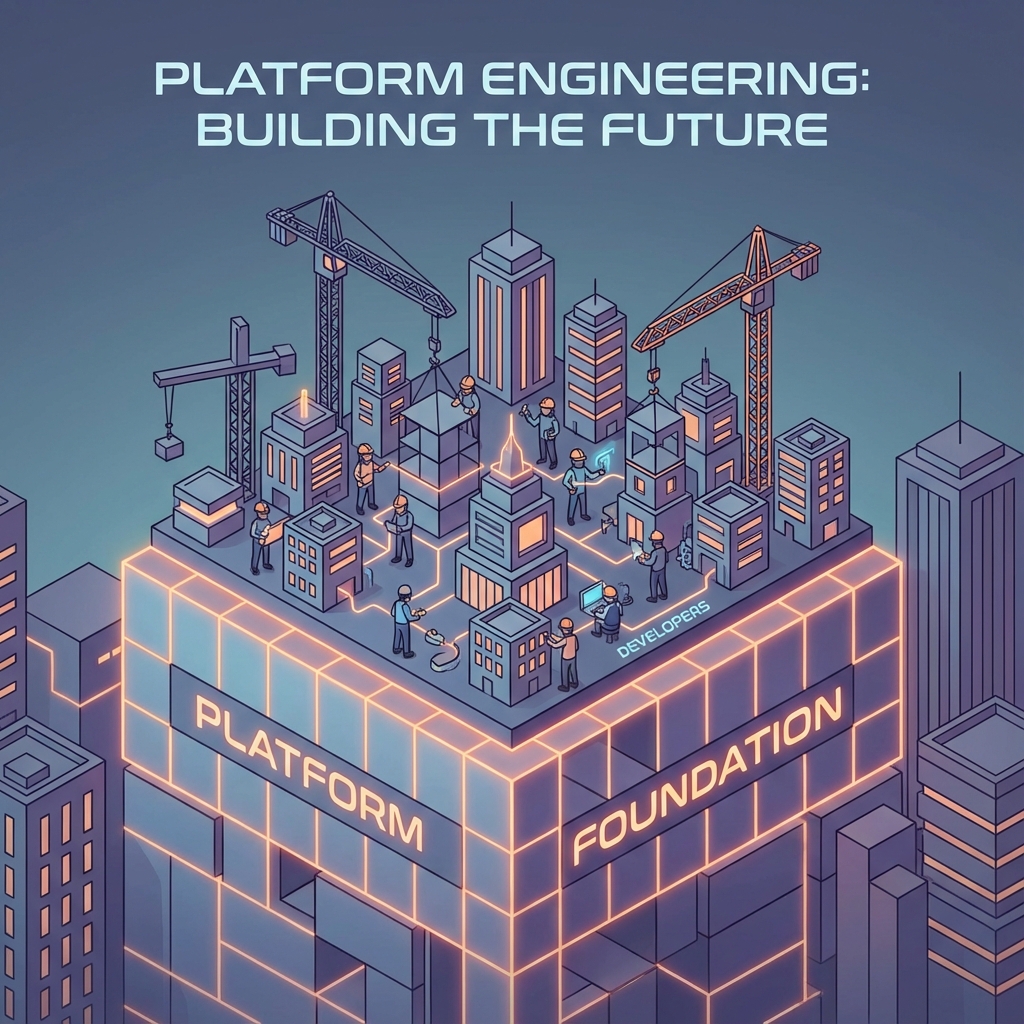
Platform Engineering is the discipline of designing and building toolchains and workflows that enable self-service capabilities for software engineering organizations.
It is NOT just "DevOps with a new name."
- DevOps is a culture (collaboration).
- Platform Engineering is a concrete team structure.
The Platform Team builds the "Golden Path". "You want a Database? Click this button. You get a Postgres instance, pre-configured with backups, monitoring, and auto-scaling. You don't need to know how Terraform works."
The IDP (Internal Developer Platform)
The IDP is the interface. It can be a CLI, a GUI (like Backstage), or an API. It glues together the fragmented tools (AWS, K8s, GitHub, Jira) into a coherent experience.
Part 2: The Core Concepts
1. Golden Paths (Paved Roads)
A Golden Path is an "opinionated, supported way of doing things."
- "If you use our standardized Spring Boot template on EKS, we guarantee it works, we monitor it, and we patch it."
- "If you want to build a custom Haskell server on bare metal... you are on your own (The Off-Road Track)."
This reduces decision fatigue. Most devs don't care how the app is deployed; they just want it deployed.
2. Cognitive Load Reduction
Team Topologies (the book) defines this perfectly.
- Stream-Aligned Teams: Feature teams (The "Product" teams). Their goal is value delivery.
- Platform Team: Support team. Their goal is to remove friction for the Stream-Aligned teams.
By abstracting away the complexity of K8s, the Platform Team frees up the Product Team to focus on business logic.
3. Self-Service (No Tickets)
The enemy of speed is the Jira Ticket. "Please provision an S3 bucket." -> Wait 3 days -> "Done."
In a Platform model:
Developer defines s3_bucket: true in their app.yaml.
The Platform (Crossplane / Terraform Operator) provisions it instantly.
Part 3: The Toolchain (Backstage & Friends)
The Interface: Backstage
Created by Spotify. It is a portal where you can see all your services, docs, and tools.
- Software Catalog: "Who owns the 'Checkout' service?"
- Scaffolder: "Create a new React App" (Runs a template script).
- TechDocs: "Docs-as-code" rendered nicely.
The Engine: Infrastructure as Code
- Terraform / OpenTofu: The standard for cloud resources.
- Crossplane: The Kubernetes-native way. You define "Composition" (Composite Resources).
- You define abstract
XPostgres. - It maps to
AWS RDSin Prod andHelm Chartin Dev. - The developer just asks for
Kind: Postgres.
- You define abstract
The Orchestrator: Kubernetes
K8s is the operating system of the platform. It handles the reconciliation loops.
Part 4: Case Study (Spotify)
Spotify invented this. They have hundreds of squads. If every squad managed their own GCP networking, it would be chaos. They built the "Golden Path" for:
- Data Pipelines.
- Microservices.
- Web Apps.
If a squad stays on the path, they get upgrades for free. This allowed them to scale to thousands of engineers while keeping high velocity.
Part 5: Implementation (Where to start?)
Don't buy a Platform. Build one. But start small.
Level 0: Wiki page with commands to copy-paste.
Level 1: A CLI tool (company-cli create-service).
Level 2: A simple dashboard showing service status.
Level 3: Full Self-Service via Backstage + Crossplane.
Warning: Do not build a "Golden Cage". If you force developers to use your platform and your platform sucks, they will hate you. Treat them as customers. Sell the platform to them. "Use this, it will save you 5 hours a week."
Conclusion: Empathy for the Developer
SRE (Site Reliability Engineering) is about Reliability. Platform Engineering is about Developer Experience (DevEx).
If your devs are happy, they ship faster. If they ship faster, the business wins. The era of "The Sysadmin who says NO" is over. We are now "The Platform Engineer who enables YES."