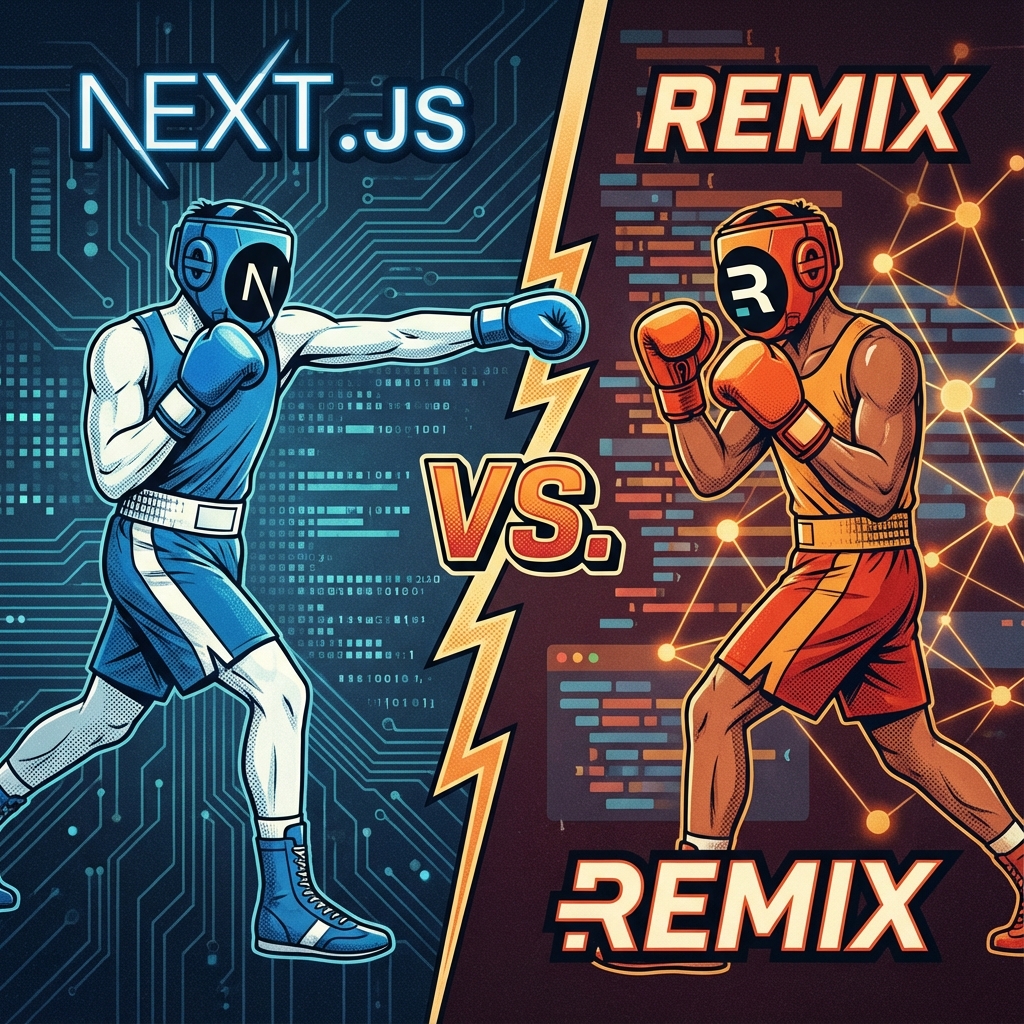
Next.js vs Remix: The Full Stack Framework War (2025)
If you are building a React application in 2025, you are almost certainly using a Meta-Framework. The days of hand-rolling configurations with create-react-app are long gone. Today, the landscape is dominated by two distinct titans:
- Next.js (by Vercel): The incumbent industry standard with a massive ecosystem.
- Remix (by Shopify): The standards-focused challenger rewriting the rules of data loading.
At first glance, they appear similar—both offer File-Based Routing, Server-Side Rendering (SSR), and TypeScript support. But look under the hood, and you uncover radically different philosophies on how the modern web should function. Whether you prioritize React Server Components (RSC) or Web Standards will define your choice.
Part 1: The Philosophy
Next.js: "Make the Server Faster"
Next.js believes the backend is slow. To fix this, it invented Static Generation (SSG) and ISR (Incremental Static Regeneration). It tries to cache the HTML at the Edge so the database is never hit. With the App Router, it introduced RSC (React Server Components) to perform logic on the server and stream it.
Remix: "Make the Network Smarter"
Remix believes the network is the bottleneck, not the backend. It relies on Web Standards (HTTP Caching, eTags). It focuses on Parallel Data Loading. It doesn't start with Static. It starts with Dynamic (SSR). "Your user data changes every second. Why are you caching the HTML?"
Part 2: Data Loading
Next.js (App Router)
You fetch data inside your component.
// app/page.tsx
export default async function Page() {
  const data = await db.query();
  return <div>{data.title}</div>;
}
Pros: Colocation. You see exactly what the component needs.
Cons: Waterfalls. If Page creates Child, and Child fetches data, the server must wait for Page to finish before Child starts. (Next.js solves this with waiting promises, but it's complex).
Remix (Loaders)
You fetch data in a separate loader function.
export async function loader() {
  return json(await db.query());
}

export default function Page() {
  const data = useLoaderData();
  return <div>{data.title}</div>;
}
Pros: Parallelization. Remix knows all data requirements for the route before it renders a single component. It fetches Page, Sidebar, and Footer data simultaneously. Cons: Separation. The data logic is separated from the UI logic.
Part 3: Mutations (Forms)
Next.js (Server Actions)
RPC-style function calls.
async function save(formData) {
  "use server";
  await db.create(formData);
  revalidatePath("/dashboard");
}

<form action={save}>...</form>;
It feels like calling a JavaScript function.
Remix (Actions)
HTML-style Form Submissions.
export async function action({ request }) {
  const formData = await request.formData();
  await db.create(formData);
  return redirect("/dashboard");
}

<Form method="post">...</Form>;
It leans on the browser. If JS is disabled, this still works (Progressive Enhancement). Remix handles the "Revalidation" automatically. After every action, it re-runs all loaders on the page to ensure fresh data.
Part 4: Nested Layouts
Remix invented this pattern (copied by Next.js App Router). The URL dictates the UI hierarchy.
URL: /sales/invoices/123
Root.tsx(Sidebar)Sales.tsx(Top Nav)Invoices.tsx(List)InvoiceDetail.tsx(Content)
In Remix, these are nested routes. When you click an invoice, only the InvoiceDetail part of the page changes.
In Next.js, the Layouts (layout.tsx) achieve the same result.
Winner: Tie. Both are excellent.
Part 5: Infrastructure Dependency
Next.js & Vercel
Next.js works best on Vercel. Features like ISR, Image Optimization, and Middleware are designed around Vercel's serverless primitives. You can self-host it (Docker), but you lose some magic (or have to configure a complex Nginx/CDN setup).
Remix & Anything
Remix is platform-agnostic. It has adapters for:
- Cloudflare Workers
- Fly.io
- AWS Lambda
- Node.js (Express)
- Bun
Because it relies on standard Request and Response objects (Web Fetch API), it runs anywhere JS runs.
Conclusion: The Decision
Choose Next.js if:
- Static Content: You are building a blog, marketing site, or e-commerce catalog where pages don't change often. SSG is unbeatable for speed.
- Job Market: Everyone knows Next.js. It's safe.
- Vercel: If you are happy paying for Vercel, the DX is seamless.
Choose Remix if:
- SaaS / Dynamic Apps: A dashboard where every user sees different data. SSR is king here.
- No Vendor Lock-in: You want to deploy to Cloudflare or a VPS.
- Simplicity: You prefer "Just HTTP" over "React Server Component Magic".
In 2025, Next.js is the IBM. Remix is the Apple. Next.js is bigger, but Remix is "thinking different". Personally? For Apps, I pick Remix. For Sites, I pick Next.js.