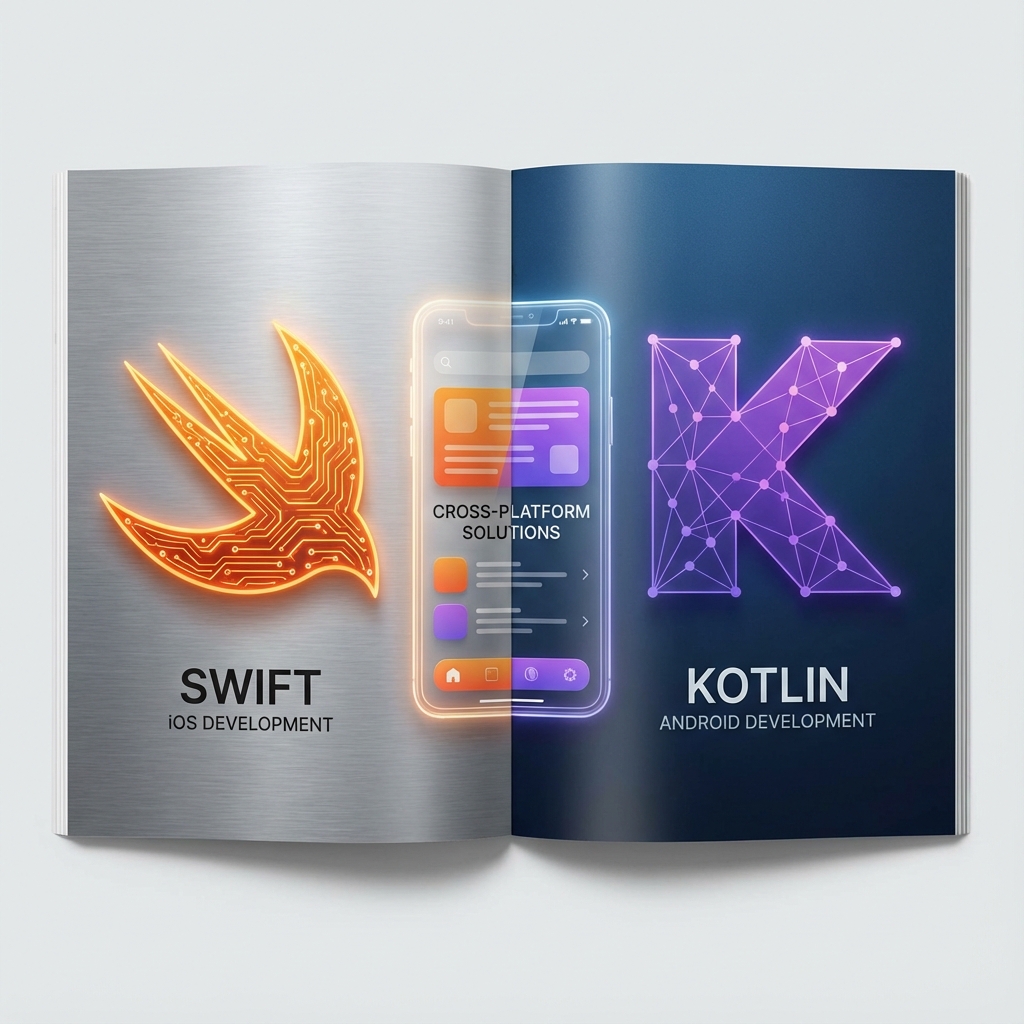
Swift vs Kotlin: The 2025 Benchmark (iOS vs Android)
If you place modern Swift code next to Kotlin code, the syntax is strikingly similar: let/val, func/fun, and optionals denoted by ?. Apple, Google, and JetBrains have seemingly converged on an "Ideal Modern Syntax" for mobile development.
But look under the hood, and you will find beasts of entirely different natures.
Swift is a compile-to-native language utilizing Automatic Reference Counting (ARC) and built on the LLVM infrastructure. Kotlin is a managed language running on the JVM (or ART on Android) with robust Garbage Collection. In this guide, we explore these deep technical differences and the rising dominance of Kotlin Multiplatform (KMP) for cross-platform logic.
Part 1: Memory Management (ARC vs GC)
Swift (ARC)
Automatic Reference Counting.
when var x goes out of scope, the ref count drops to 0. Deallocation is instant.
Pros: Deterministic. Low memory footprint.
Cons: Retain Cycles. You must manually type weak var or unowned self in closures, or memory leaks happen.
class Person {
    var apartment: Apartment?
    deinit { print("Deallocated") }
}
Kotlin (Garbage Collection)
Runs on Android Runtime (ART). Pros: No Retain Cycles. You can have circular references, and the GC will find them eventually. Cons: GC Pauses (Micro-stutters during scrolling). Higher RAM usage.
Part 2: Concurrency (Actors vs Coroutines)
Kotlin Coroutines
The gold standard. "Lightweight Threads".
You can launch 100,000 coroutines on a single thread.
suspend fun indicates async.
Structured Concurrency (viewModelScope) ensures that if a screen closes, all network requests are cancelled automatically.
viewModelScope.launch {
    val user = api.getUser() // Suspends here
    viewState.value = user
}
Swift Concurrency (async/await + Actors)
Introduced in Swift 5.5.
Acts similar to Kotlin, but enforces strict thread safety via Actors.
An actor protects its own state. The compiler prevents race conditions.
actor BankAccount {
    var balance = 0
    func deposit(amount: Int) {
        balance += amount
    }
}
// You must 'await' to talk to an actor.
Part 3: The Ecosystem (SPM vs Gradle)
Swift Package Manager (SPM)
Integrated into Xcode.
Uses a simple Package.swift file.
Fast resolution.
Strict.
Gradle (Kotlin/Android)
The most powerful and frustrating build system ever created. Groovy vs Kotlin DSL. "Syncing Project..." takes forever. But it is incredibly flexible for complex multi-module setups.
Part 4: Kotlin Multiplatform (KMP)
This is where Kotlin is winning. You can write your "Business Logic" (Networking, Database, Models) in Kotlin.
- Compile to JVM Bytecode for Android.
- Compile to Native Machine Code (via LLVM) for iOS.
Swift can call Kotlin code as if it were an Objective-C framework. Swift is trapped in the Apple ecosystem (mostly). Kotlin is invading iOS.
Conclusion: Which to Learn?
If you want a job at a startup in 2025:
- Learn React Native (for breadth).
If you want a job at a Big Tech company:
- Learn Swift and Kotlin.
They are so similar that knowing one implies 80% knowledge of the other. The best mobile engineers describe themselves as "Mobile Engineers," not "iOS Engineers."