Vector Databases Explained: The Architecture of AI Memory (2025)
In 2020, the term "Vector Database" was arcane jargon, familiar only to search engineers at tech giants like Google and Meta. By 2025, it has become a foundational component of the modern web stack, sitting alongside PostgreSQL and Redis as an essential tool.
Why has this shift occurred? Because Large Language Models (LLMs) are amnesiac geniuses.
While models like GPT-4 possess vast general knowledge up to their training cutoff, they know nothing about you, your company, or events that happened five minutes ago. To function in the real world, they need a way to recall specific, private, and recent information.
Vector Databases bridge this gap, acting as the Long-Term Memory for AI applications. Unlike SQL databases that store rows, or NoSQL databases that store JSON documents, Vector Databases store meanings.
In this guide, we will unpack the black box of HNSW algorithms, Cosine Similarity, and High-Dimensional Geometry to explain exactly how machines "remember."
Part 1: The Problem with Keywords
To understand vectors, we must look at what came before: Keyword Search (BM25 / TF-IDF).
Imagine you are searching for: "A furry pet that purrs."
Keyword Search (SQL/Elasticsearch):
- Looks for documents containing "furry", "pet", "purrs".
- Match: "This furry coat is made of synthetic pet hair." (Wrong meaning).
- Miss: "The cat slept on the sofa." (Right meaning, but doesn't contain the words "furry" or "purrs").
Semantic Search (Vector):
- Understands the meaning of "furry pet that purrs" is close to "cat".
- Finds: "The cat slept on the sofa."
Vectors solve the Vocabulary Mismatch Problem.
Part 2: What is a Vector? (The Grocery Store Analogy)
We explained Embeddings in our previous guide, but let's visualize the storage.
Imagine a grocery store.
- Aisle 1: Fruits.
- Aisle 2: Vegetables.
- Aisle 10: Motor Oil.
We can assign every product a coordinate: [Aisle Number].
- Apple:
[1] - Banana:
[1] - Oil:
[10]
Distance: Apple and Banana are close (distance 0). Apple and Oil are far (distance 9).
But "Aisle" is not enough. Fruits can be Red or Yellow.
Let's add a dimension: [Aisle, Color (Red=0, Yellow=10)].
- Apple:
[1, 0] - Banana:
[1, 10]
Now Apple and Banana are further apart. Modern Embedding models (like OpenAI's text-embedding-3) use 1,536 dimensions. They encode nuance: Is it formal? Is it negative? Is it about technology? Is it a noun?
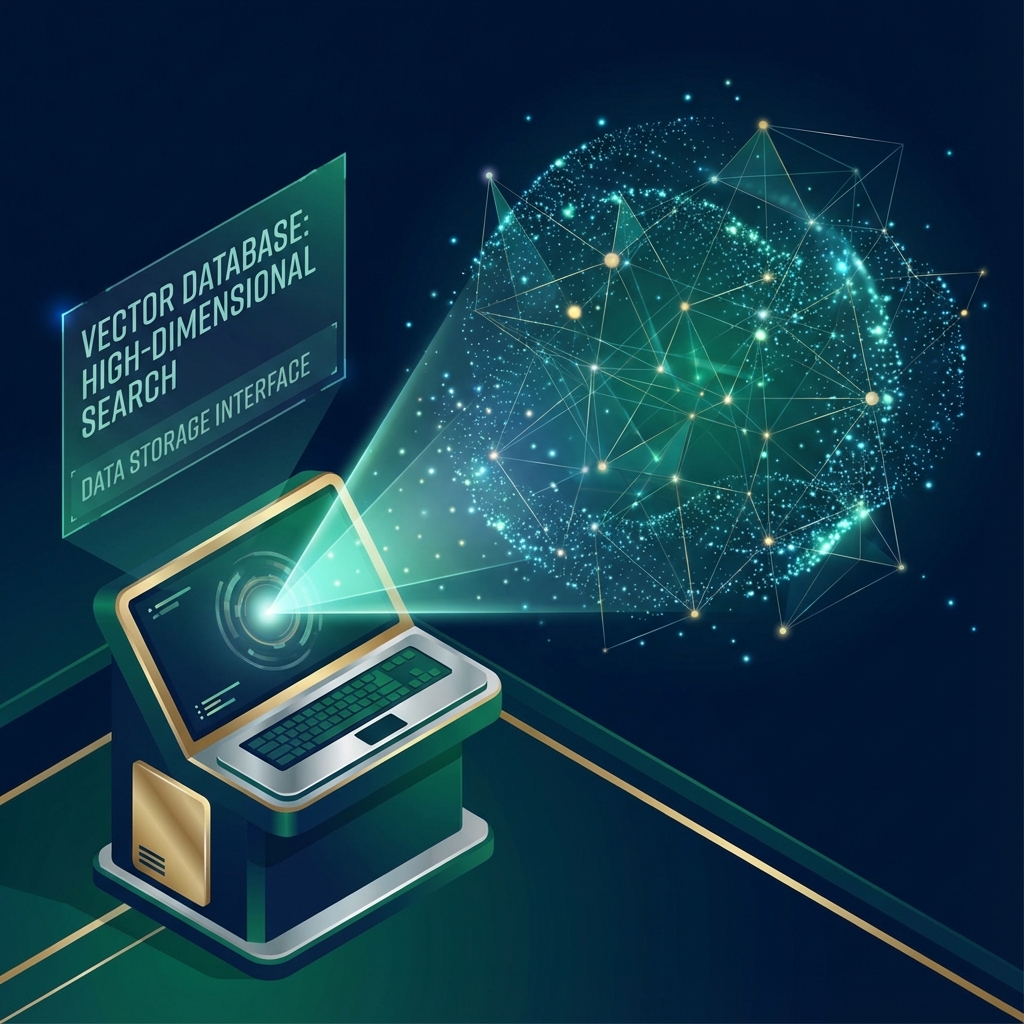
A Vector Database is a system designed to store these 1,536-dimensional coordinates and efficiency find the "nearest neighbors" to a query point.
Part 3: The Search Algorithms (How it works)
Searching 1 million vectors is easy. Brute force math works. Searching 1 billion vectors is hard.
3.1 k-NN (Exact Search)
Compare the query vector against every single vector in the database.
- Accuracy: 100%.
- Speed: O(N). Too slow for big data.
3.2 ANN (Approximate Nearest Neighbors)
We trade a tiny bit of accuracy (99% instead of 100%) for massive speed (O(log N)). How? We need an Index.
3.3 HNSW (Hierarchical Navigable Small World)
This is the industry standard algorithm (used by Pinecone, Weaviate, Chroma).
Imagine a city map.
- Layer 0 (Ground Level): Connects every house to its neighbor. High detail, slow navigation.
- Layer 1 (Main Roads): Connects neighborhoods.
- Layer 2 (Highways): Connects cities.
When searching:
- Start at the Highway Layer. Zoom to the general area of the query.
- Drop down to Main Roads. Refine position.
- Drop to Ground Level. Find the exact nearest neighbor.
This "Skip List" structure allows finding a needle in a haystack in milliseconds.
3.4 IVF (Inverted File Index)
Used by Faiss (Facebook AI Similarity Search).
- Cluster the existing vectors into 100 "buckets" (Voronoi cells).
- When a query comes in, figure out which bucket it belongs to.
- Only search the vectors inside that bucket (ignoring 99% of the DB).
Part 4: Similarity Metrics (The Ruler)
How do we measure distance?
- Euclidean Distance (L2): The straight-line distance. Good for physical coordinates. $$ d = \sqrt{(x_2-x_1)^2 + (y_2-y_1)^2} $$
- Cosine Similarity: The angle between vectors. Ignores magnitude (length).
- "Good" (Vector A)
- "Good Good Good" (Vector B)
- Cosine similarity says these are identical (same direction).
- This is usually <strong>The Best Choice</strong> for text.
- Dot Product: Measures magnitude and direction. Useful for recommendation systems (where "rating intensity" matters).
Part 5: The Landscape (Market Analysis)
The Vector DB market is crowded.
5.1 The Specialists (Native Vector DBs)
Built from scratch for vectors.
- Pinecone: The leader. Fully managed SaaS. Easy to use. HNSW-based.
- Weaviate: Open source. GraphQL interface. "Module" system (vectorizes data for you).
- Chroma: AI-native. Simple, local, Pythonic. Good for dev/test.
- Milvus: Heavy-duty, highly scalable, designed for massive enterprise data.
5.2 The Generalists (Added Vector Support)
Traditional DBs adding vector plugins.
- pgvector (PostgreSQL): The disruption. "Just use Latex."
- Pros: ACID compliance, Joins, you already have it.
- Cons: Slightly slower than specialized DBs at massive scale (100M+), but catching up fast.
- Redis: Fast, in-memory vector search.
- Elasticsearch: Added
dense_vectortype. Good for Hybrid Search.
Trend: Most companies start with Pinecone (ease) or pgvector (stack simplicity).
Part 6: Filtering (The Arch-Nemesis)
"Find me documents about 'AI' (Vector) that were published 'Yesterday' (Metadata)." This is harder than it looks.
-
Post-Filtering:
- Step 1: Find top 100 vectors about "AI".
- Step 2: Filter this list for date = "Yesterday".
- Risk: What if none of the top 100 were from yesterday? You get 0 results, even if relevant docs exist.
-
Pre-Filtering:
- Step 1: Find all docs from "Yesterday".
- Step 2: Perform vector search on that subset.
- Risk: If the subset is small, it's fast. If the subset is huge, brute force is slow. HNSW graphs struggle with pre-filtering because the graph structure ignores metadata.
Solution: Modern DBs use "Filtered HNSW" or specific bitmap indexing to handle this efficiently.
Part 7: Building a Simple Vector Search (Python)
Let's do it without a database first, using numpy, then faiss.
import numpy as np

# 1. Create fake data (1000 vectors of dimension 128)
d = 128
nb = 1000
db_vectors = np.random.random((nb, d)).astype('float32')

# 2. Query vector
query_vector = np.random.random((1, d)).astype('float32')

# --- Method 1: Brute Force (Numpy) ---
# Calculate distance to ALL vectors
# (Using Dot Product for simplicity)
scores = np.dot(db_vectors, query_vector.T)
# Find index of max score
best_idx = np.argmax(scores)
print(f"Nearest Neighbor Index: {best_idx}")

# --- Method 2: Faiss (Optimized Index) ---
import faiss

index = faiss.IndexFlatL2(d)   # Brute force L2 index
index.add(db_vectors)          # Build index
D, I = index.search(query_vector, k=5) # Search top 5

print(f"Top 5 Indices: {I}")
print(f"Distances: {D}")
Part 8: Hybrid Search (The Best of Both Worlds)
Vector search is fuzzy. Sometimes you want exact keyword matches (e.g., searching for a specific Product SKU "XJ-900"). Vector embeddings might map "XJ-900" to "XJ-800" because they look similar.
Hybrid Search = Vector Score + Keyword Score.
$$ Score = \alpha \cdot VectorScore + (1-\alpha) \cdot KeywordScore $$
- Run Semantic Search (Vectors).
- Run Keyword Search (BM25).
- Normalize scores (0 to 1).
- Fuse results (Reciprocal Rank Fusion).
This is crucial for E-commerce and Legal Search.
Conclusion: The New Stack
The "LAMP Stack" (Linux, Apache, MySQL, PHP) defined the web 2.0 era. The "AI Stack" defines the 2025 era:
- LLM (Model)
- Orchestration (LangChain/LlamaIndex)
- Vector Database (Memory)
- Embedding Model (Encoder)
Vector Databases are not a fad. They are the file system of the AI age. Whether you choose a managed service like Pinecone or stick with trusty Postgres+pgvector, understanding how to index meaning is now a required skill for every backend engineer.
Recommendation Guide
- Prototype: Chroma or Pinecone (Free tier).
- Production (Small/Medium): pgvector (Keep stack simple).
- Production (Large/Complex): Weaviate or Milvus (Scale & Features).
- E-commerce: Elasticsearch (Strong hybrid search).