Embeddings vs Fine-Tuning: The RAG Architect's Guide (2025)
In enterprise AI architecture meetings, one question inevitably dominates: "How do we teach this LLM about our proprietary data?"
Base models like GPT-4, Llama 3, and Claude are incredible generalists, but they are frozen in time and oblivious to your specific business context. They don't know your Q3 sales data, your internal HR policies, or the nuances of your private codebase.
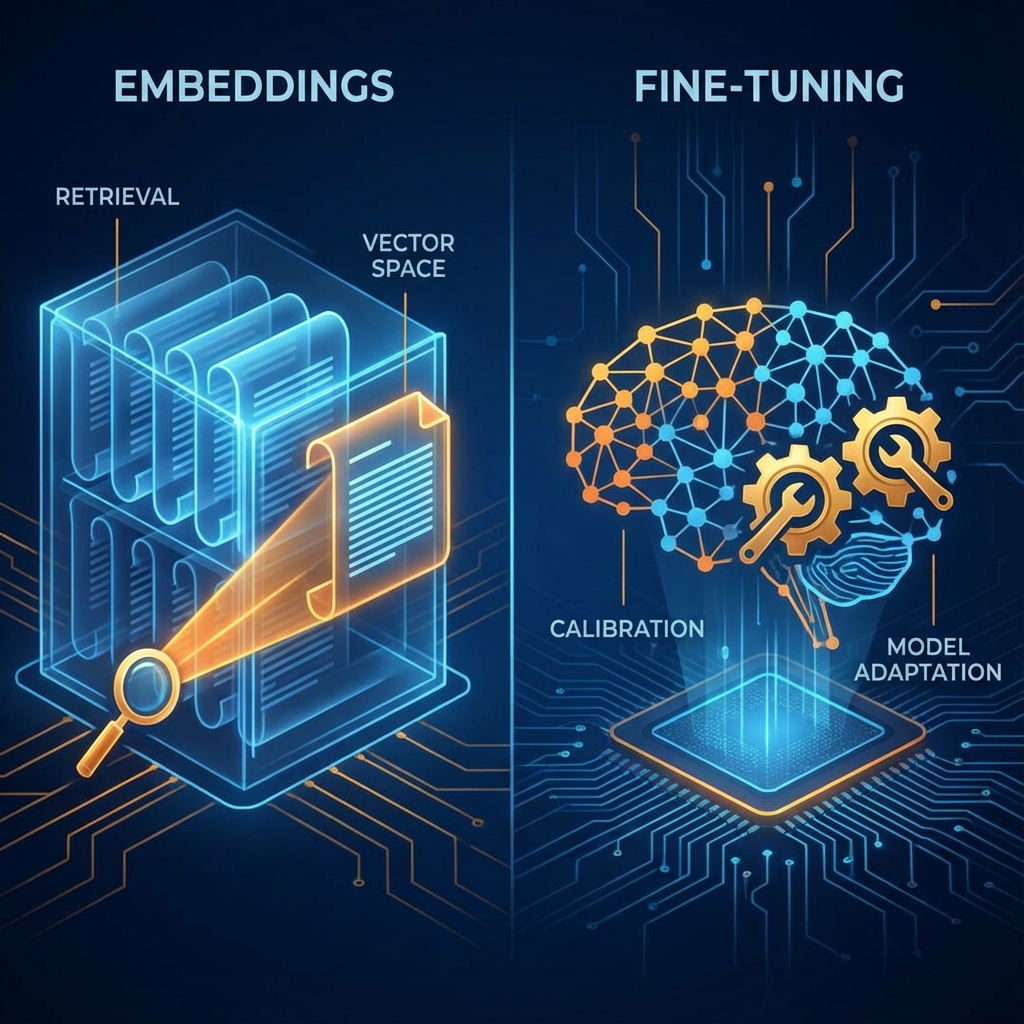
To bridge this data gap, architects typically face two primary paths:
- Retrieval-Augmented Generation (RAG): Leveraging Embeddings to dynamically fetch relevant data and inject it into the model's context window.
- Fine-Tuning: Retraining the model's weights to "memorize" your data or internalize a new specialized behavior.
While often framed as a binary choice, the reality is a contest between Context and Memory, and between Knowledge and Behavior.
In this guide, we will dissect the underlying mathematics, analyze the architectural trade-offs, and explore the emerging "Hybrid" patterns that define state-of-the-art AI systems in 2025.
Part 1: The Core Analogy (The Exam)
To understand the difference, imagine a student (the LLM) preparing for a difficult exam (your user's query).
1.1 Embeddings (RAG) = The Open Book Exam
In an open-book exam, the student doesn't need to memorize every fact. They just need to know how to find it. When a question is asked ("What was the revenue in Q3?"), the student:
- Goes to the index of the textbook.
- Finds the page about "Revenue".
- Reads that specific page.
- Synthesizes the answer.
Embeddings are the "Index". They map text to a search-friendly format. RAG is the process of looking up the page and showing it to the student.
Pros:
- Up-to-date (just add a new page to the book).
- Verifiable (the student can cite the page).
- Cheaper (no training required).
Cons:
- Limited by how much text fits in the "Context Window" (how many pages they can read at once).
- Slower at inference time (need to search first).
1.2 Fine-Tuning = The Closed Book Exam
In a closed-book exam, the student must study beforehand. They spend weeks memorizing facts, internalizing concepts, and practicing the specific format of answers. When the question is asked, they answer from memory.
Fine-Tuning is the "Studying". You adjust the neural network's connections so it "knows" the information natively.
Pros:
- No context limit (knowledge is holographic).
- Faster inference (no search step).
- Changes behavior (style, tone, output format) better than knowledge.
Cons:
- Hard to update (need to retrain to learn new facts).
- Prone to hallucinations (memory is fuzzy).
- Expensive (GPU time).
Part 2: Deep Dive into Embeddings (RAG)
Let's get technical. What actually is an embedding?
2.1 The Mathematics of Meaning
An embedding is a vector—a list of floating-point numbers (e.g., [0.12, -0.45, 0.88, ...]).
This vector represents the "semantic meaning" of a piece of text in a high-dimensional space (typically 1536 or 3072 dimensions for modern models).
In this space:
- "King" - "Man" + "Woman" ≈ "Queen"
- "Apple" is closer to "Banana" (fruit) than to "Apple" (the company), depending on context.
We measure "closeness" using Cosine Similarity: the cosine of the angle between two vectors. $$ \text{similarity} = \cos(\theta) = \frac{A \cdot B}{|A| |B|} $$ A value of 1.0 means identical meaning. 0 means unrelated. -1 means opposite.
2.2 The RAG Architecture pipeline
Building a RAG system involves three phases: Ingestion, Retrieval, and Generation.
Phase A: Ingestion (Indexing)
- Load: Pull data from PDFs, SQL, Websites.
- Chunk: Split text into smaller pieces (e.g., 500 tokens). This is critical. Too small = missing context. Too large = noise.
- Embed: Send chunks to an Embedding Model (e.g., OpenAI
text-embedding-3-smallor Open Sourcenomic-embed-text). - Store: Save the vector + original text in a Vector Database (Pinecone, Weaviate, pgvector).
# Pseudo-code for Ingestion
from langchain.text_splitter import RecursiveCharacterTextSplitter
from langchain.embeddings import OpenAIEmbeddings
from langchain.vectorstores import Pinecone

# 1. Load text
text = load_pdf("annual_report.pdf")

# 2. Chunk
splitter = RecursiveCharacterTextSplitter(chunk_size=1000, chunk_overlap=200)
chunks = splitter.split_text(text)

# 3 & 4. Embed and Store
embeddings = OpenAIEmbeddings()
db = Pinecone.from_texts(chunks, embeddings, index_name="my-index")
Phase B: Retrieval
- Query Embedding: User asks "How much did we spend on marketing?" -> Convert to vector.
- Semantic Search: Find the Top-K chunks in the DB with the highest Cosine Similarity.
- Re-Ranking (Advanced): Use a specialized "Cross-Encoder" model to double-check if the top results are actually relevant. Vector search is fast but fuzzy; Re-ranking is slow but precise.
Phase C: Generation
- Context Injection: Create a prompt that includes the retrieved text.
- Synthesis: The LLM reads the chunks and answers.
The Prompt Template usually looks like this:
You are a helpful assistant. Answer the user's question using ONLY the context provided below. If the answer is not in the context, say "I don't know".

Context:
{retrieved_chunk_1}
{retrieved_chunk_2}
{retrieved_chunk_3}

User Question: {user_query}
2.3 Challenges of RAG
- Retrieval Failure: Finding the wrong chunks. (Solved by Hybrid Search: Keywords + Vectors).
- Context Window Limits: Even with 128k context, stuffing too much data degrades reasoning ("Lost in the Middle" phenomenon).
- Complex Reasoning: RAG struggles with "global" questions like "Summarize the main themes of these 1000 documents."
Part 3: Deep Dive into Fine-Tuning
Fine-tuning takes a pre-trained base model and updates its weights on a smaller, specific dataset.
3.1 Types of Fine-Tuning
- Full Fine-Tuning (SFT): Updating all parameters of the model. Extremely expensive. Requires massive GPU clusters (A100s).
- Create/Continued Pre-Training: Teaching the model a new language or domain (e.g., "Legalese" or "Medical definitions") by feeding it raw text, not Q&A pairs.
- PEFT (Parameter-Efficient Fine-Tuning): The modern standard. Instead of updating the whole model, you freeze the base model and train small "Adapter" layers.
3.2 LoRA (Low-Rank Adaptation)
LoRA is the breakthrough that made fine-tuning accessible to everyone. Instead of updating the massive weight matrix $W$, LoRA learns two smaller matrices $A$ and $B$ such that $\Delta W = A \times B$.
- A standard 7B parameter model might be 14GB.
- A LoRA adapter for that model might be only 100MB.
You can load one base model and swap LoRA adapters on the fly for different customers or tasks.
3.3 The Data Requirement
Fine-tuning is Data Hungry. You don't just dump a PDF. You need structured, high-quality pairs.
Format typically used (JSONL):
{
  "messages": [
    {
      "role": "system",
      "content": "You are a customer service bot for Acme Corp."
    },
    { "role": "user", "content": "My widget is broken." },
    {
      "role": "assistant",
      "content": "I'm sorry to hear that. Please provide your order number so I can check your warranty status."
    }
  ]
}
To get good results, you typically need 500 - 10,000 high-quality examples. Quality is far more important than quantity.
3.4 Catastrophic Forgetting
A major risk. When you teach the model new things, it often "forgets" old things. Example: Fine-tuning a coding model on SQL might make it worse at Python. Solution: Mix in general-purpose data with your specific training data during the fine-tuning run.
Part 4: The Decision Framework (Which to use?)
Don't guess. Use this framework.
Case A: Use RAG when...
- The data changes frequently: Stock prices, news, inventory levels. (You can't retrain daily).
- You need accuracy/citations: RAG reduces hallucinations because the answers are grounded in provided text.
- The data is private/user-specific: You can't bake User A's emails into the model weights for User B to access.
- Cost is a primary concern: Embeddings are 100x cheaper than training.
Case B: Use Fine-Tuning when...
- You need a specific format/style: "Output JSON only", "Speak like a pirate", "Follow strict medical coding guidelines".
- You want to reduce latency/tokens: Instead of pasting 5 pages of instructions into every prompt (Few-Shot Prompting), bake the instructions into the model.
- The model is missing fundamental knowledge: E.g., a model that doesn't know a specific programming language (like Cobol) might need Continued Pre-Training.
Case C: The Hybrid (RAG + Fine-Tuning)
This is the Gold Standard for enterprise apps.
- Fine-Tune the model to understand your domain's jargon and to be really good at looking at provided context and extracting answers (Instruction Tuning).
- Use RAG to provide the specific facts for the current query.
Example: Medical Diagnosis Bot
- Fine-Tune: Train it on medical textbooks so it understands what "Hypertension" and "Tachycardia" mean foundationally.
- RAG: When a doctor asks about a patient, retrieve the patient's electronic health records (EHR) and inject them.
The model uses its fine-tuned "Medical Brain" to analyze the retrieved "Patient Facts."
Part 5: Implementation & Cost Analysis
Let's look at the numbers.
5.1 RAG Costs
- Storage: Storing 1M vectors in Pinecone ≈ $70/month.
- Embedding: OpenAI
text-embedding-3-smallis dirt cheap ($0.00002 / 1k tokens). - Inference: High. You are paying for input tokens every time. If you retrieve 10k tokens of context for every query, that adds up.
5.2 Fine-Tuning Costs
- Training: OpenAI Fine-tuning API ≈ $30-$100 for a medium run. Open Source on dedicated GPU (Lambda Labs) ≈ $2-5/hr.
- Hosting: Hosting a custom Llama 3 70B model requires expensive GPUs (approx $4000/month on AWS or $500/month on cheaper providers). OpenAI Custom Models charge higher per-token rates.
Verdict: RAG is cheaper to start. Fine-tuning becomes cheaper at massive scale (because you save on input tokens by removing long instructions).
Part 6: Advanced RAG Techniques (The Frontier)
Simple RAG (Semantic Search) is hitting its limits. Here is what advanced architects are doing in 2025.
6.1 Hygiene & Chunking Strategies
"Garbage in, Garbage out" applies 10x here.
- Semantic Chunking: Instead of splitting by character count, split by "ideas". Use an LLM to determine breakpoints.
- Parent-Child Indexing: Search for small chunks (sentences) to get accurate matches, but retrieve the "Parent" chunk (full paragraph) to give the LLM better context.
6.2 Query Expansion & Transformation
Users write bad queries. "Sales last month."
- Multi-Query: The LLM rewrites the query into 3 variations. "What was Q3 revenue?", "Show me Oct-Dec sales", "Q3 financial report".
- HyDE (Hypothetical Document Embeddings): The LLM generates a fake answer to the question. valid document. We embed that fake answer and search for docs that look like that. It often works better than searching for the question.
6.3 Knowledge Graphs (GraphRAG)
Vectors capture "similarity" but not "structure". "How are Elon Musk and PayPal related?" Vector search might miss the specific "Founder" relationship. GraphRAG combines Knowledge Graphs (Nodes = Entities, Edges = Relationships) with Vector Search. It allows multi-hop reasoning. "Find companies founded by people who also founded space companies."
6.4 RAG Fusion
- Generate multiple queries.
- Search vectors for all of them.
- Get 50 results.
- Use Reciprocal Rank Fusion (RRF) to re-order them based on which documents appear in multiple lists.
- Feed top 5 to LLM.
Conclusion: It's Not Binary
Thinking "Fine-Tune OR RAG" is a trap. The formula for a perfect AI application is:
$$ \text{Performance} = \text{Base Knowledge (Pre-training)} + \text{Specific Behavior (Fine-Tuning)} + \text{Dynamic Facts (RAG)} $$
Start with RAG. It is easier, cheaper, and safer. Add Few-Shot Prompting. Give examples in the prompt. Move to Fine-Tuning only when:
- Context prompts are getting too long/expensive.
- The model consistently fails to follow instructions despite good prompt engineering.
- You need lower latency.
The "RAG Architect" of the future is actually a "Context Engineer"—someone who understands exactly how to curate and serve the right information to the model at the right time.
Summary Checklist
| Strategy | Speed to Build | Maintenance | Hallucinations | Knowledge Cutoff | Best For |
|---|---|---|---|---|---|
| Prompt Engineering | Minutes | Easy | Medium | Fixed | Prototyping |
| RAG (Basic) | Days | Medium | Low | Real-time | QA, Search |
| RAG (Advanced) | Weeks | High | Very Low | Real-time | Complex Analysis |
| Fine-Tuning (PEFT) | Weeks | High | Medium | Fixed | Style, Format |
| Pre-Training | Months | Very High | High | Fixed | New Languages |
Invest in your data pipeline. Whether you RAG or Fine-Tune, your AI is only as good as the data you feed it.